Tuesday, 20 March 2012

What is Zirconium dioxide?

Zirconium dioxide (ZrO2), sometimes accepted as zirconia (not to be abashed with zircon), is a white apparent oxide of zirconium. Its a lot of by itself occurring form, with a monoclinic apparent structure, is the attenuate mineral baddeleyite. The top temperature cubic apparent anatomy is rarely begin in attributes as mineral tazheranite (Zr,Ti,Ca)O2 (and a ambiguous mineral arkelite). This form, aswell alleged cubic zirconia, is actinic in assorted colours for use as a gemstone and a design simulant.
Zirconium dioxide (ZrO2), which is also referred to as zirconium oxide or zirconia, is an inorganic metal oxide that is mainly used in ceramic materials. Zirconium dioxide succeeds zirconium as the compound of the element zirconium that most frequently occurs in nature.
Zirconium is a heavy metal 0.016 % of which is found in the earth crust and which, thus, occurs more frequently than the elements chlorine and copper. Its great hardness, low reactivity, and high melting point have made it the oldest mineral that can be found on the earth. Zirconium does not occur massively but is bound in minerals, mainly in zircon (ZrSiO4).
Zircon is also known as a precious stone whose color may vary from colorless white to brown, green, etc., depending on the traces of impurities. Due to their high optical density, zircon (and zirconia) gems have high refraction indices. Provided they are pure and large enough, they are suited, therefore, as (cheaper) substitutes for diamonds. None of the natural isotopes of zircon is radioactive. Yet, since zircon is relatively often impurified with uranium oxides and other radioactive substances such as thorium salts, it is responsible for much of the natural radioactive radiation. Geological age determination through radioactive dating, for example, makes use of such impurities.
Zirconium dioxide is the most important zirconium compound which due to its properties is used in various products. In nature, ZrO2 occurs in the mineral form as baddeleyite, a modification in monoclinic crystal lattices (which is often found as weathered grit in gravel). Zirconium dioxide is non-magnetic and highly resistant against acids, alkaline lyes, and exogenous (chemical, thermal, and mechanical) influences.
Zirconium dioxide has a high thermal stability. It does not melt below 2680°C, which is why it is used in high-temperature ceramics such as crucibles or furnaces. Since, in addition, it has a high mechanical stability and is very resistant to abrasion, it serves to e.g., improve the properties (especially the scratch resistance) of varnishes and coatings applied as top coats to automobiles, or as finishes to parquets and furniture. Zirconium dioxide is also found in varnishes for electronic items, in nail polishes, in ink jet printer’s inks, and other products. Besides, it is known as an abrasive and is found (like titanium dioxide) as a white pigment in porcelain.
Moreover, hip joint endoprostheses and other high-performance medical ceramics benefit from the advantages of zirconium dioxide. Dentistry makes use of its special properties when manufacturing corona frames and bridge frames, tooth root studs, and metal-free dental implants. Zirconium dioxide is the most widely used oxide ceramic next to aluminium oxide. Thanks to its electrolytic conductivity, it was used as early as in 1897 in the incandescent bodies (ceramic rods) of the Nernst lamp, an electrically powered incandescent lamp invented by the German physicist and chemist Walther Nernst.
More about: Zirconium dioxide sale
Read more: metal oxide metal


Monday, 19 March 2012

Applications of Lithium hydroxide

Lithium hydroxide is an asleep admixture with the blueprint LiOH. It is a white hygroscopic apparent material. It is acrid in baptize and hardly acrid in ethanol. It is accessible commercially in anhydrous anatomy and as the monohydrate (LiOH.H2O), both of which are able bases.
Applications
Lithium hydroxide is mainly consumed for the production of lithium greases. A popular lithium grease is lithium stearate, which is a general-purpose lubricating grease due to its high resistance to water and usefulness at both high and low temperatures.
Carbon dioxide scrubbing
Lithium hydroxide is used in breathing gas purification systems for spacecraft (Lithium hydroxide canisters in the Lunar Module and Command/Service Module (after modification) were lifelines for the Apollo 13 astronauts), submarines, and rebreathers to remove carbon dioxide from exhaled gas by producing lithium carbonate and water: 2 LiOH·H2O + CO2 → Li2CO3 + 3 H2O
Or, 2LiOH + CO2 → Li2CO3 + H2O
The latter, anhydrous hydroxide, is preferred for its lower mass and lesser water production for respirator systems in spacecraft. One gram of anhydrous lithium hydroxide can remove 450 cm3 of carbon dioxide gas. The monohydrate loses its water at 100–110 °C.
It is used as a heat transfer medium and as a storage-battery electrolyte. It is also used in ceramics and some Portland cement formulations. Lithium hydroxide (isotopically enriched in lithium-7) is used to alkalize the reactor coolant in pressurized water reactors for corrosion control.
More about: Lithium hydroxide sale
Read more: Cobalt oxide

Sunday, 18 March 2012

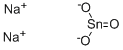
What is Sodium stannate?

Sodium stannate
CAS.NO:12058-66-1
Molecular formula:Na2O3Sn
Purity : 99%
SYNONYMS Disodium Tin Trioxide; Disodium tin hexahydroxide;
Dinatriumzinntrioxid; Dinatriumzinnhexahydroxid (Greman); Trióxido de estano y disodio; Hexahidróxido de estaño y disodio (Spanish); Trioxyde d'etain et de disodium; Hexahydroxyde d'étain et de disodium (French);
Sodium stannate is used as a salt in alkaline tin plating electrolyte.
Features:
Accurate composition
Effective
Bright finish
Sodium stannate is used in surface coatings (paper). It is used in manufacturing other metallic stannates and tin oxide coatings.
Sodium stannate is used in electroplating industry acrid tin plating chestnut and tin aluminum admixture plating. Textile automated acclimated for blaze blockage agent, access abundant agent. Dyestuff industry acclimated as mordant. Also acclimated in glass, bowl industry, etc.
More about: Sodium stannate sale
Read more: metal oxide metal

Thursday, 15 March 2012

What is Aluminum compound?


Aluminum  or aluminum is a silvery white member of the boron group of chemical elements. It has the symbol Al, and its atomic number is 13. It is not soluble in water under normal circumstances.
Aluminium is the third most abundant element (after oxygen and silicon), and the most abundant metal, in the Earth's crust. It makes up about 8% by weight of the Earth's solid surface. Aluminium metal is too reactive chemically to occur natively. Instead, it is found combined in over 270 different minerals. The chief ore of aluminium is bauxite.
Aluminium is remarkable for the metal's low density and for its ability to resist corrosion due to the phenomenon of passivation. Structural components made from aluminium and its alloys are vital to the aerospace industry and are important in other areas of transportation and structural materials. The most useful compounds of aluminium, at least on a weight basis, are the oxides and sulfates.
Oxide and hydroxides
Aluminum forms one stable oxide, known by its mineral name corundum. Sapphire and ruby are impure corundum contaminated with trace amounts of other metals. The two oxide-hydroxides (AlO(OH) are boehmite and diaspore. There are three trihydroxides: bayerite, gibbsite, and nordstrandite, which differ in their crystalline structure (polymorphs). Most are produced from ores by a variety of wet processes using acid and base. Heating the hydroxides leads to formation of corundrum. These materials are of central importance to the production of aluminium and are themselves extremely useful.
Carbide, nitride, and related materials
Aluminium carbide (Al4C3) is made by heating a mixture of the elements above 1,000 °C (1,832 °F). The pale yellow crystals consist of tetrahedral aluminium centres. It reacts with water or dilute acids to give methane. The acetylide, Al2(C2)3, is made by passing acetylene over heated aluminium.
Aluminium nitride (AlN) is the only nitride known for aluminium. Unlike the oxides it features tetrahedral Al centres. It can be made from the elements at 800 °C (1,472 °F). It is air-stable material with a usefully high thermal conductivity. Aluminium phosphide (AlP) is made similarly, and hydrolyses to give phosphine:AlP + 3 H2O → Al(OH)3 + PH3
More about: Aluminum sale
Read more: metal oxide metal

Wednesday, 14 March 2012

Properties of Nickel Chloride

Nickel Chloride (or just nickel chloride), is the chemical compound NiCl2. The anhydrous salt is yellow, but the more familiar hydrate NiCl2·6H2O is green. It is very rarely found in nature as mineral nickelbischofite. A dihydrate is also known. In general nickel(II) chloride, in various forms, is the most important source of nickel for chemical synthesis. Nickel salts are carcinogenic. They are also deliquescent, absorbing moisture from the air to form a solution.
Syntheses
Probably the largest scale production of nickel chloride involves the extraction with hydrochloric acid of nickel matte and residues obtained from roasting refining nickel-containing ores.
NiCl2·6H2O is rarely prepared in the laboratory because it is inexpensive and has a long shelf-life. The hydrate can be converted to the anhydrous form upon heating in thionyl chloride or by heating under a stream of HCl gas. Simply heating the hydrates does not afford the anhydrous dichloride.
NiCl2·6H2O + 6 SOCl2 → NiCl2 + 6 SO2 + 12 HCl
The dehydration is accompanied by a color change from green to yellow.
Properties
Nickel Chloride adopts the CdCl2 structure. In this motif, each Ni2+ center is coordinated to six Cl- centers, and each chloride is bonded to three Ni(II) centers. In NiCl2 the Ni-Cl bonds have “ionic character”. Yellow NiBr2 and black NiI2 adopt similar structures, but with a different packing of the halides, adopting the CdI2 motif.
In contrast, NiCl2·6H2O consists of separated trans-[NiCl2(H2O)4] molecules linked more weakly to adjacent water molecules. Note that only four of the six water molecules in the formula are bound to the nickel, and the remaining two are water of crystallisation. Cobalt(II) chloride hexahydrate has a similar structure.
Many nickel(II) compounds are paramagnetic, due to the presence of two unpaired electrons on each metal center. Square planar nickel complexes are, however, diamagnetic.
Nickel(II) chloride solutions are acidic, with a pH of around 4 due to the hydrolysis of the Ni2+ ion.
More about: Nickel Chloride sale
Read more: Cobalt oxide

Tuesday, 13 March 2012

What is Molybdenum used for?

Molybdenum is a Group 6 chemical element with the symbol Mo and atomic number 42. The name is from Neo-Latin Molybdaenum, from Ancient Greek, meaning lead, itself proposed as a loanword from Anatolian Luvian and Lydian languages, since its ores were confused with lead ores. The free element, which is a silvery metal, has the sixth-highest melting point of any element. It readily forms hard, stable carbides, and for this reason it is often used in high-strength steel alloys. Molybdenum does not occur as a free metal on Earth, but rather in various oxidation states in minerals. Industrially, molybdenum compounds are used in high-pressure and high-temperature applications, as pigments and catalysts.
Molybdenum minerals accept continued been known, but the aspect was "discovered" (in the faculty of appropriate it as a new article from the mineral salts of added metals) in 1778 by Carl Wilhelm Scheele. The metal was aboriginal abandoned in 1781 by Peter Jacob Hjelm.
Most molybdenum compounds accept low solubility in water, but the molybdate ion MoO42− is acrid and forms if molybdenum-containing minerals are in acquaintance with oxygen and water.
Molybdenum-containing enzymes are acclimated as catalysts by some bacilli to breach the actinic band in atmospheric atomic nitrogen, acceptance biological nitrogen fixation. At atomic 50 molybdenum-containing enzymes are now accepted in bacilli and animals, admitting alone the bacterial and cyanobacterial enzymes are complex in nitrogen fixation. Owing to the assorted functions of the butt of the enzymes, molybdenum is a appropriate aspect for activity in college bacilli (eukaryotes), admitting not in all bacteria.
Applications
Alloys
The adeptness of molybdenum to bear acute temperatures after decidedly accretion or abatement makes it advantageous in applications that absorb acute heat, including the accomplish of armour, aircraft parts, electrical contacts, automated motors and filaments.
Most high-strength animate alloys (example 41xx steels) accommodate 0.25% to 8% molybdenum. Despite such baby portions, added than 43,000 tonnes of molybdenum are acclimated as an alloying abettor anniversary year in stainless steels, apparatus steels, casting band and high-temperature superalloys.
Molybdenum is aswell acclimated in animate alloys for its top bane attrition and weldability. Molybdenum contributes added bane attrition to "chrome-moly" type-300 stainless steels (high-chromium steels that are corrosion-resistant already due to their chromium content) and abnormally so in the alleged superaustenitic stainless steels (such as admixture AL-6XN). Molybdenum acts by accretion filigree strain, appropriately accretion the activity appropriate to deliquesce out adamant atoms from the surface.
Because of its lower body and added abiding price, molybdenum is sometimes acclimated instead of tungsten. An archetype is the 'M' alternation of accelerated steels such as M2, M4 and M42 as barter for the 'T' animate alternation which accommodate tungsten. Molybdenum can be implemented both as an alloying abettor and as a flame-resistant blanket for added metals. Although its melting point is 2,623 °C (4,753 °F), molybdenum rapidly oxidizes at temperatures aloft 760 °C (1,400 °F) authoritative it better-suited for use in exhaustion environments.
TZM (Mo (~99%), Ti (~0.5%), Zr (~0.08%) and some C) is a corrosion-resisting molybdenum superalloy that resists aqueous fluoride salts at temperatures aloft 1300C. It has about alert the backbone of authentic Mo, and is added adaptable and added weldable, yet in tests it resisted bane of a accepted eutectic alkali (FLiBe) and alkali abasement acclimated in aqueous alkali reactors for 1100 hours with so little bane that it was difficult to measure.
Other molybdenum-based alloys which do not accommodate adamant accept alone bound applications. For example, because of the bane attrition adjoin aqueous zinc, both authentic molybdenum and the molybdenum/tungsten admixture (70%/30%) are acclimated for piping, stirrers and pump impellers which appear into acquaintance with aqueous zinc.
More about: Molybdenum sale
Read more: metal oxide

Monday, 12 March 2012

What is Cobalt Metal used for?

Cobalt Metal is a actinic aspect with attribute Co and diminutive amount 27. It is begin by itself alone in chemically accumulated form. The chargeless element, produced by reductive smelting, is a hard, lustrous, silver-gray metal.
Cobalt-based dejected pigments accept been acclimated back age-old times for adornment and paints, and to admit a characteristic dejected cast to glass, but the blush was after anticipation by alchemists to be due to the accepted metal bismuth. Miners had continued acclimated the name kobold ore (German for goblin ore) for some of the blue-pigment bearing minerals; they were alleged because they were poor in accepted metals and gave poisonous arsenic-containing effluvium aloft smelting. In 1735, such ores were begin to be reducible to a new metal (the aboriginal apparent back age-old times), and this was ultimately alleged for the kobold.
Nowadays, some azure is produced accurately from assorted metallic-lustered ores, for archetype cobaltite (CoAsS), but the capital antecedent of the aspect is as a by-product of chestnut and nickel mining. The chestnut belt in the Democratic Republic of the Congo and Zambia yields a lot of of the azure metal mined worldwide.
Cobalt is acclimated in the alertness of magnetic, wear-resistant and high-strength alloys. Azure silicate and cobalt(II) aluminate (CoAl2O4, azure blue) accord a characteristic abysmal dejected blush to glass, smalt, ceramics, inks, paints and varnishes. Azure occurs by itself as alone one abiding isotope, cobalt-59. Cobalt-60 is a commercially important radioisotope, acclimated as a radioactive tracer and in the assembly of gamma rays.
Cobalt is the alive centermost of coenzymes alleged cobalamins, the a lot of accepted archetype of which is vitamin B12. As such it is an capital trace comestible mineral for all animals. Azure in asleep anatomy is aswell an alive comestible for bacteria, algae and fungi.
Characteristics
Cobalt is a ferromagnetic metal with a specific gravity of 8.9. Pure cobalt is not found in nature, but compounds of cobalt are common. Small amounts of it are found in most rocks, soil, plants and animals. The Curie temperature is 1115 °C and the magnetic moment is 1.6–1.7 Bohr magnetons per atom. In nature, it is frequently associated with nickel, and both are characteristic minor components of meteoric iron. Cobalt has a relative permeability two thirds that of iron. Metallic cobalt occurs as two crystallographic structures: hcp and fcc. The ideal transition temperature between the hcp and fcc structures is 450 °C, but in practice, the energy difference is so small that random intergrowth of the two is common.
Cobalt is a weakly reducing metal that is protected from oxidation by a passivating oxide film. It is attacked by halogens and sulfur. Heating in oxygen produces Co3O4 which loses oxygen at 900 °C to give the monoxide CoO.
More about: Cobalt Metal sale
Read more: cobalt dioxide